

GTI performance parts fall into two categories that look similar on a spec sheet. Each carries notably different implications for fitment, calibration, and warranty coverage. A VW GTI owner evaluating an intake, suspension component, or exhaust is making a decision that goes beyond part price and installation cost. Understanding these categories helps Jacksonville GTI owners choose modifications that hold up technically and avoid unnecessary coverage risk. This breakdown covers how each category works, what the law says, and what the ECU tuning question involves.
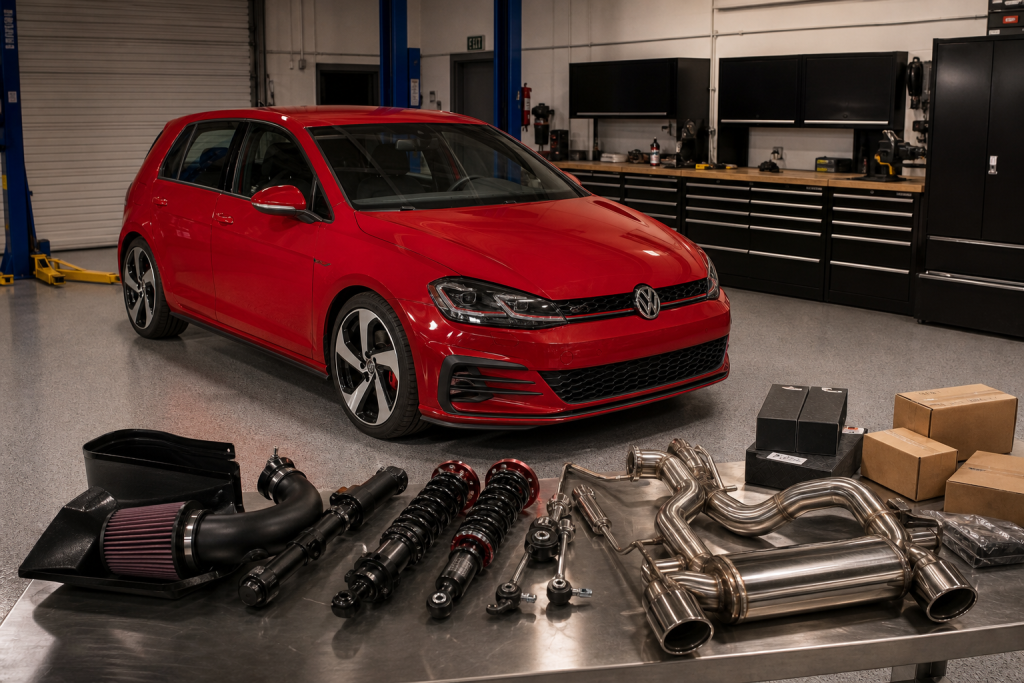
What OEM GTI Performance Parts Are and How They Differ From Dealer Accessories
OEM GTI performance parts are components engineered by Volkswagen or its approved suppliers to the same tolerance standards as factory equipment. They interact with the GTI’s EA888 turbocharged engine, its fuel delivery mapping, and its suspension geometry without requiring recalibration of adjacent components. An OEM intake, for instance, flows air at a rate the ECU’s fuel trim tables already account for. Fitment is precise. It is built to a specific dimensional and flow specification.
Dealer accessories occupy a different category. VW R-Line accessories are styling components approved for installation by VW. They carry warranty coverage when installed by a VW dealer following the approved installation procedure. However, most R-Line components are not output-oriented. They address visual and comfort modifications rather than engine output, suspension tuning, or exhaust flow. Conflating R-Line accessories with OEM parts leads to incorrect coverage assumptions. The following points clarify how the two categories differ at the installation level.
- OEM performance parts are engineered to factory tolerance and interact with existing ECU calibration without modification. They are sourced through VW’s parts supply chain and carry the same warranty coverage as original equipment when installed correctly.
- Dealer accessories are VW-approved for cosmetic or comfort modification and carry installation warranty when installed by an authorized VW dealer. They do not calibrate to engine output parameters and do not substitute for output-oriented OEM components.
Knowing which category a part falls into before purchase clarifies which warranty protections apply and what recalibration the installation may require.
How Aftermarket GTI Parts Differ in Fitment and What That Means Mechanically
Aftermarket GTI parts are produced by third-party manufacturers to their own dimensional and material specifications. Quality varies widely across the aftermarket segment. A well-engineered aftermarket intake from a reputable manufacturer may flow air within acceptable range of OEM specification. A lower-quality product may introduce fitment gaps, seal failures, or flow irregularities that create secondary problems beyond the part itself.
Fitment tolerance is the core technical distinction. An OEM intake seats against the throttle body and airbox connection points to a precise dimensional standard. An aftermarket intake that is slightly off-dimension creates an air leak at the connection point. That leak introduces unmeasured air into the intake tract. The GTI’s ECU reads mass airflow from the MAF sensor upstream of the leak. Unmeasured air downstream of the sensor causes a lean fuel trim condition. That lean condition places additional load on the turbocharger and raises combustion temperature. So a fitment gap that seems minor at installation creates a chain of secondary effects across connected components.
Suspension components carry the same risk. An aftermarket strut mount or control arm bushing that does not seat to OEM geometry shifts the factory suspension geometry. However, that shift may not be immediately visible without a post-installation geometry check. A GTI on out-of-specification geometry will show accelerated tire wear, steering feedback changes, and handling that diverges from factory calibration. The part itself may have seemed to fit during installation. But the deviation it introduced compounds across every mile driven after the install.
What the Magnuson-Moss Warranty Act Covers for GTI Owners
The Magnuson-Moss Warranty Act governs written warranties on consumer products in the United States. It prohibits manufacturers from voiding a warranty solely because the owner used aftermarket parts. However, that protection is narrower than most GTI owners assume. The law does not guarantee that a modified GTI will receive warranty coverage on all claims. It shifts the burden of proof to the manufacturer to demonstrate that the aftermarket part caused the failure in question.
That burden-of-proof standard is the critical detail. If a GTI owner installs an aftermarket intake and later faces a turbocharger failure, VW can deny the claim by demonstrating that the intake contributed to the failure. The lean fuel trim condition from a poorly fitting intake creates exactly the causal chain a warranty evaluator can follow. So Magnuson-Moss does not protect a GTI owner from a denial. It requires the manufacturer to justify the denial with evidence of causation.
The law also does not apply to modifications that VW specifically excludes in writing within the warranty terms. ECU tuning is one such category in most manufacturer warranty agreements. A software modification that rewrites boost targets, fuel tables, and ignition timing falls outside the bolt-on hardware protection Magnuson-Moss addresses most clearly. In practice, the law protects owners who install quality parts, maintain documentation, and can show the modification did not causally connect to the failure.
Why Does ECU Tuning Carry a Different Warranty Risk Than Bolt-On Parts?
A bolt-on part modifies one system at a time. An aftermarket intake changes airflow. An aftermarket exhaust changes backpressure. Each modification is discrete and its effect on adjacent components is bounded. An ECU tune operates differently. It rewrites the operating parameters the entire powertrain runs against simultaneously. Boost pressure targets, fuel delivery maps, ignition timing curves, and torque limiters all change in a single software modification.
The GTI’s EA888 engine is turbocharged and direct-injection. Those two characteristics make it particularly sensitive to ECU calibration changes. A boost increase from a stage one tune raises load on the turbocharger bearings, increases combustion temperature, and demands more from the intercooler. Without supporting hardware changes, those increased demands run against components calibrated for factory boost levels. Turbocharger bearing wear, piston ring stress, and intercooler saturation are not immediate failures. However, they develop faster under elevated boost than under factory calibration.
Furthermore, most current VW GTI ECUs log modification history. A dealership technician running a diagnostic scan can identify whether the ECU has been flashed to a non-factory calibration. That log entry changes the warranty evaluation conversation before the verbal discussion begins. A bolt-on modification does not leave the same diagnostic trail. So from a warranty standpoint, ECU tuning and bolt-on hardware modifications occupy different risk categories even on the same vehicle.
What GTI Owners Should Know Before Modifying at Tom Bush Volkswagen
GTI modifications are not inherently warranty-ending decisions. The risk level varies by modification type, part quality, and how well the owner documents what was installed and when. A GTI owner who installs a quality component, maintains the original part, and keeps installation records is in a far stronger position for any future warranty conversation. Several steps apply before any modification begins.
- Photograph the factory component and surrounding area before removal. Record the mileage, date, and installer name at the time of installation. Keep the original part in the event the modification needs to be reversed for a warranty claim evaluation.
- Confirm the part specification against the GTI’s model year and build. A part listed as compatible may carry dimensional tolerances that vary by production year. Confirming specification before installation prevents fitment surprises that are difficult to diagnose after the fact.
- Ask Tom Bush Volkswagen about dealer-installed accessory options before sourcing aftermarket components. Some upgrades are available as VW-approved accessories with defined warranty coverage when installed by the Tom Bush Volkswagen service team.
The GTI was built with enthusiast ownership in mind. VW’s own accessory catalog reflects that. Navigating modifications with an understanding of fitment, warranty law, and ECU sensitivity lets Jacksonville GTI owners enhance the car without unnecessary coverage risk. The Tom Bush Volkswagen team can identify which upgrades carry the lowest risk and which require careful evaluation before proceeding.
Connect with us


