

The 2025 Volkswagen Taos is engineered for drivers who want efficiency without sacrificing refinement, structure, or long term usability. In the compact SUV segment, many vehicles chase fuel economy numbers at the expense of driving stability, cabin quality, or powertrain durability. The Taos takes a more balanced approach, pairing compact exterior dimensions with a thoughtfully engineered platform that supports daily commuting, urban maneuverability, and highway confidence.
This guide breaks down how the Taos is built, how its systems work in real world driving, and what Jacksonville shoppers should evaluate when deciding if a compact SUV aligns with their needs.
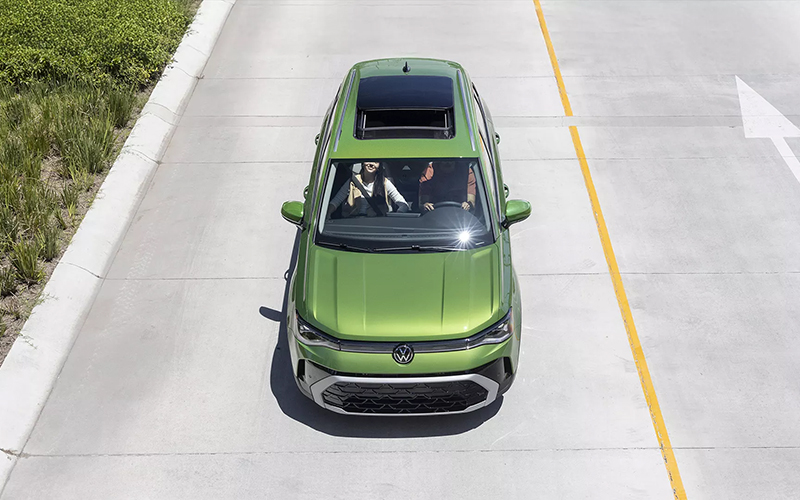
Platform Design and Compact SUV Proportions
The Taos is built on Volkswagen’s MQB architecture, a modular platform engineered to balance weight distribution, structural rigidity, and interior efficiency. This platform allows Volkswagen to maximize cabin space while keeping the exterior footprint manageable for city driving and parking.
Platform characteristics include:
- Transverse engine layout for efficient packaging
- High strength steel in critical load bearing areas
- Optimized crash structure without excess weight
- Balanced front to rear weight distribution for predictable handling
For Jacksonville drivers navigating dense traffic, tight parking areas, and frequent stop and go driving, this platform design supports both agility and comfort.
Powertrain Engineering and Real World Efficiency
The 2025 Taos is powered by a turbocharged 1.5 liter four cylinder engine designed to deliver usable torque at low and mid range speeds. Rather than focusing on peak horsepower figures, Volkswagen engineers tuned this engine for responsiveness in everyday driving.
Powertrain highlights include:
- Turbocharged design for strong low rpm torque
- Direct fuel injection for improved combustion efficiency
- Engine management systems calibrated for smooth throttle response
- Automatic transmission tuning focused on fuel economy and drivability
This setup supports confident merging, steady highway cruising, and efficient urban driving without requiring aggressive throttle input.
Fuel Economy and Driving Behavior
Efficiency in the Taos is achieved through system integration rather than a single technology. Engine tuning, transmission behavior, and vehicle weight all contribute to real world fuel economy.
Efficiency supporting factors include:
- Lightweight platform construction
- Optimized gear ratios for cruising speeds
- Aerodynamic body shaping
- Engine start stop technology where equipped
For drivers with daily commutes or frequent highway travel, the Taos delivers fuel efficiency without the tradeoff of sluggish response that often accompanies economy focused vehicles.
Interior Design and Passenger Comfort
Despite its compact classification, the Taos offers an interior designed around usable space rather than minimal dimensions. Seat positioning, roofline height, and window placement all contribute to an open cabin feel.
Interior design considerations include:
- Upright seating posture for improved visibility
- Ample rear legroom for a compact SUV
- Wide door openings for easy entry and exit
- Cargo space that supports groceries, gear, and luggage
This balance makes the Taos suitable for small families, professionals, and drivers downsizing from larger vehicles without feeling constrained.
Technology and Driver Interface
Volkswagen integrates technology in the Taos with an emphasis on clarity and consistency. Systems are designed to support the driver rather than distract from the driving experience.
Technology features include:
- Digital Cockpit display for vehicle and navigation data
- Central infotainment screen with logical menu structure
- Apple CarPlay and Android Auto integration
- Physical controls for core functions like volume and climate
This hybrid approach ensures usability in real world conditions where touchscreens alone can become cumbersome.
Safety and Driver Assistance Systems
The Taos incorporates driver assistance systems that operate cohesively rather than independently. Sensors and cameras are calibrated to provide support without abrupt or intrusive behavior.
Available systems include:
- Forward collision warning with automatic braking
- Blind spot monitoring
- Rear traffic alert
- Adaptive cruise control
These systems are designed to enhance awareness while allowing the driver to remain in control.
How the Taos Fits the Compact SUV Segment
The compact SUV segment is crowded, but the Taos differentiates itself through engineering discipline rather than feature overload.
The Taos appeals to drivers who value:
- Efficient daily transportation
- Refined ride quality
- Predictable handling
- Long term ownership confidence
It is particularly well suited for drivers who want SUV versatility without stepping into larger, less efficient vehicles.
What Jacksonville Buyers Should Evaluate
When deciding if the Taos is the right fit, Jacksonville buyers should consider:
- Daily commute length and traffic conditions
- Parking and maneuverability needs
- Fuel efficiency priorities
- Interior space requirements
- Technology usability preferences
The Taos is optimized for drivers who spend most of their time on paved roads and want a vehicle that feels composed in both urban and highway settings.
Final Perspective on the 2025 Volkswagen Taos
The 2025 Volkswagen Taos delivers compact SUV practicality through thoughtful engineering rather than compromise. Its efficient powertrain, balanced platform, and intuitive interior design make it a strong choice for drivers seeking dependable transportation with modern refinement.
For Jacksonville drivers looking to balance efficiency, comfort, and long term value, the Taos represents Volkswagen’s disciplined approach to compact SUV design, focused on how vehicles are actually used every day.
Connect with us


Recent Blog Entries
- Volkswagen Maintenance Plan Cost Guide – Coverage, Value, and Long-Term Ownership Benefits
- 2026 Volkswagen Golf GTI Performance Guide – Power, Handling, and Engineered VW Precision
- Volkswagen APR in 2026: What Jacksonville Buyers Should Know About Rates, Incentives, and Value
- 2026 Volkswagen Atlas Cross Sport Buyer’s Guide – Style, Comfort, and VW Performance Engineering
- Volkswagen Maintenance Plan Cost Guide – Coverage, Value, and Long-Term Ownership Benefits