Blog / Jacksonville Volkswagen Service

Volkswagen Repair Estimates Explained: Cost and Verification

Volkswagen repair estimates explained starts with understanding how diagnostics, labor, parts, inspections, and repair verification shape the final repair cost before service approval. Modern Volkswagen vehicles use advanced electronics, communication modules, sensors, and calibration procedures that require more than a quick visual inspection. A repair estimate is not simply a price quote. It is a breakdown of the testing, repair planning, replacement parts, labor procedures, and verification steps required to identify and correct a vehicle issue properly.

What a Volkswagen Repair Estimate Includes

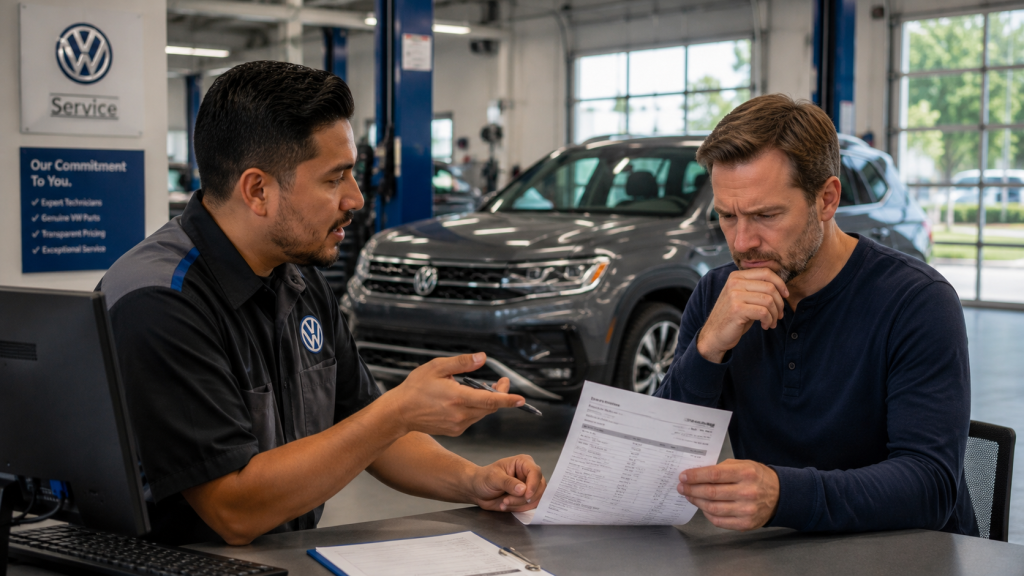
What are you paying for in a repair estimate? A repair estimate combines diagnostic testing, technician labor, replacement components, inspections, taxes, and service procedures tied to the specific issue being addressed.

When a Volkswagen enters the service department, the estimate process usually begins with concern verification. The technician reviews the issue reported by the driver, checks warning lights, performs an inspection, and connects the vehicle to factory level diagnostic equipment. That process creates the foundation for the estimate.

A Volkswagen repair estimate may include:

  • Diagnostic testing
  • Technician labor time
  • OEM Volkswagen parts
  • Electronic calibration procedures
  • Fluid replacement
  • Taxes and shop fees
  • Multi point inspection findings

The estimate structure changes based on the repair type. A brake service estimate will look different from a module communication issue or cooling system repair because each service requires different labor procedures, tools, testing steps, and component access.

For shoppers, the important detail is understanding that the estimate reflects the repair path required to diagnose and correct the issue fully, not simply replace one part.

Why Diagnostic Testing Is Part of Repair Pricing

Why is there a diagnostic fee before repairs even begin? Diagnostic testing is the process technicians use to identify the actual source of the problem before replacement work starts.

Modern Volkswagen models contain multiple onboard control modules that communicate across the vehicle. A warning light or fault code does not automatically identify the failed component. Fault codes point technicians toward a system area that requires deeper testing.

For example, a check engine light tied to an oxygen sensor code does not always mean the oxygen sensor itself failed. Wiring problems, vacuum leaks, fuel delivery concerns, exhaust leaks, or communication interruptions can create similar code patterns. The technician must verify the root cause before repairs are approved.

Diagnostic procedures may involve:

  • Full system scanning
  • Live data monitoring
  • Voltage testing
  • Circuit inspection
  • Pressure testing
  • Sensor signal analysis
  • Road testing

Volkswagen diagnostic procedures can become more involved when electrical communication modules are connected to multiple systems at once. One issue can create secondary faults across several modules. That is why diagnostic labor exists separately from the actual repair.

The goal is not replacing parts until the warning disappears. The goal is identifying the actual failure source before unnecessary repairs happen.

How Labor Times and OEM Parts Shape Repair Cost

Why do labor charges vary between repairs? Technician labor is calculated using standardized repair operations based on the complexity of the repair, required disassembly, testing procedures, and calibration steps.

Some Volkswagen repairs require limited access and short installation time. Others involve major component removal, electronic programming, or recalibration after installation. Even repairs involving similar parts can have different labor totals because of where the component is located and how many procedures are required before replacement can begin.

Volkswagen electronic architecture also changes the repair process. After replacing certain components, technicians may need to perform:

  • Sensor calibration
  • Module coding
  • Software adaptation
  • Steering angle resets
  • Radar alignment
  • Communication verification scans

OEM Volkswagen parts also influence estimate structure. Factory parts are designed around exact fitment, communication compatibility, and calibration standards already programmed into the vehicle architecture. That matters with modern driver assistance features, electronic throttle systems, adaptive safety equipment, and engine management controls.

An aftermarket part may physically fit the vehicle but still create communication problems, warning lights, or calibration interruptions if the module data does not match factory specifications correctly.

For Volkswagen repairs involving electronics, sensors, drivability concerns, or safety equipment, part compatibility plays a major role in repair accuracy.

Why Repair Estimates Sometimes Change After Inspection

Why can repair pricing increase after the inspection process begins? Some issues are not fully visible until components are removed or secondary testing is completed.

An estimate may begin with the most visible failure based on the initial inspection. Once technicians access the repair area, additional wear, damaged hardware, fluid contamination, wiring problems, or secondary failures can become visible.

A cooling system leak may uncover additional hose deterioration. Brake repairs may reveal rotor damage or seized hardware. Suspension repairs may expose worn bushings or alignment issues that were hidden during the first inspection.

Volkswagen repairs involving turbocharged engines, electrical systems, or sealed components can require partial disassembly before the full repair scope becomes clear.

Estimate revisions may happen because of:

  • Hidden component damage
  • Additional failed parts
  • Corrosion
  • Fluid contamination
  • Wiring deterioration
  • Secondary electronic faults
  • Calibration requirements discovered during repair

That does not automatically mean unnecessary repairs are being added. It means the technician now has access to information that was not visible during the first stage of inspection.

A transparent repair process explains what changed, why it changed, and how the added repair relates to the original concern.

How Volkswagen Repairs Are Verified Before Vehicle Return

How do technicians confirm the repair fixed the problem? Repair verification is the final testing process performed after installation and calibration procedures are complete.

For Volkswagen vehicles, this process can involve clearing faults, rescanning modules, monitoring live sensor data, road testing, recalibrating electronic systems, and confirming proper communication between onboard modules.

Repair verification may include:

  • Post repair scan testing
  • Warning light confirmation
  • Road testing
  • Sensor calibration checks
  • Leak inspections
  • Battery charging system review
  • Communication module verification

This final stage matters because the repair process does not end when a part is installed. Modern Volkswagen vehicles rely on connected electronic communication across multiple systems. A replacement component may still require adaptation procedures before the vehicle recognizes the repair properly.

For drivers, repair verification provides confidence that the original concern was corrected, supporting systems are communicating correctly, and the vehicle is ready to return to normal operation.

Volkswagen repair estimates are built around diagnosis, confirmation, repair planning, and validation. Understanding how those steps connect makes the estimate easier to evaluate and helps shoppers understand where repair costs originate before approving service.
Posted in:

Related Posts

Volkswagen Service Intervals: What Owners Need to Know

Volkswagen service intervals are not built on a fixed mileage number. That distinction matters for every driver planning a maintenance schedule. The system monitors how the car is monitored and calculates service needs from those inputs. Jacksonville VW owners who understand the system can plan service appointments more accurately. Both premature and delayed maintenance become avoidable. This breakdown covers the interval display, oil service calculation, service tiers, and what the annual inspection involves. How Does the VW Service Interval Display Work? The VW Service Interval Display is not a simple mileage counter. It is a multi-item monitoring system that tracks several maintenance components independently. In fact, oil quality, brake fluid condition, and inspection timing each carry their own threshold within the display. When any item reaches its service point, the display alerts the driver with a message identifying which service is due. Specifically, the oil service calculation draws from a set of vehicle inputs. Engine load, trip duration, ambient temperature, and RPM patterns all factor into the oil quality model running in the background. A VW Jetta on frequent short trips in Jacksonville's summer heat will see an oil service reminder earlier than one driven on longer highway routes. Both climate and trip pattern shift the calculation. The system responds to how the car is driven. It does not assume every driver covers the same miles on the same roads. more However, multi-item tracking is what confuses drivers most. A service reminder that appears shortly after an oil change is not a system error. It may indicate that brake fluid has reached its moisture threshold, or that the vehicle's annual inspection interval has elapsed. In fact, each item within the display triggers independently. So a fresh oil service does not reset every item in the system. Understanding this prevents the assumption that a recent oil change means all service needs are current. VW Oil Change Intervals and Why Synthetic Oil Changes the Calculation VW gasoline engines require full synthetic oil meeting the VW 502.00 specification. Models with diesel particulate filters require VW 507.00. The synthetic specification is not a preference. It is what the oil interval calculation assumes. A VW that receives conventional oil will reach that oil's protection limit before the display triggers a reminder. The display's calculation assumes synthetic oil's longer protection window. Beyond the specification requirement, the mechanism behind the extended interval is shear stability. Synthetic oil maintains its viscosity under high-temperature and high-pressure engine use longer than conventional oil. In a VW Golf GTI's turbocharged engine, oil passes through the turbocharger bearing at high shaft speeds and temperatures. Indeed, synthetic oil holds its protective film at those temperatures far longer than a conventional product at the same viscosity grade. That retention supports an interval of up to 10,000 miles under favorable driving patterns. Jacksonville's stop-and-go traffic compresses that interval. Short trips, high ambient temperatures, and frequent braking degrade oil faster than the system's most optimistic calculation assumes. A Jacksonville VW owner in urban traffic may see the service reminder between 5,000 and 7,000 miles even with the correct synthetic oil. So following the display rather than a fixed mileage assumption is the more accurate approach. What Is the Difference Between a Minor and Major VW Service? VW service appointments follow a tiered structure. Understanding the difference prevents drivers from assuming one type covers everything the other does. So knowing which tier applies at each visit helps Jacksonville VW owners plan for time and cost without surprises. The two tiers cover the following. A minor service centers on oil and filter replacement, topping off fluids to the correct levels, and a visual inspection of wear items including brakes, tires, and lights. It addresses the consumable service items that require attention most frequently. A major service covers everything in the minor service and adds a more thorough inspection of mechanical components, spark plug replacement on applicable models, air filter service, cabin filter replacement, and a detailed check of steering, suspension, and drivetrain components. Furthermore, most current VW models follow a two-year or 20,000-mile major service cycle. The exact interval varies by model and driving pattern. A driver who skips a major service misses spark plug replacement and mechanical inspection items that oil service alone does not cover. Tom Bush Volkswagen tracks both tiers in the vehicle's service history, which supports accurate interval planning. The Annual Inspection and Why It Exists Separately From Oil Service However, the annual inspection is not triggered by oil quality or mileage. It is a time-based maintenance event that exists independently of the oil service cycle. A VW Tiguan receiving three oil changes in a calendar year still requires an annual inspection at the 12-month mark. The two service types address different aspects of vehicle maintenance and are not interchangeable. That distinction matters when scheduling. Several items fall within the standard annual inspection scope at Tom Bush Volkswagen. Brake pad thickness measurement and rotor condition evaluation on all four corners, with caliper and hardware inspection to confirm free movement. Tire pressure, tread depth, and visual sidewall inspection, along with a check of wheel torque and alignment indicators. Lighting function across all exterior lights, including brake lights, turn signals, and headlight aim verification. Fluid level confirmation for coolant, brake fluid, power steering fluid where applicable, and windshield washer fluid, with a check for any visible leaks at hose connections and seals. In addition, the inspection provides a documented snapshot of the vehicle's condition at a fixed point in time. That record supports warranty coverage, resale value, and the early identification of wear items. A driver relying solely on oil service reminders may go more than a year without a formal inspection. Safety-critical items fall outside any service review in that gap. What Jacksonville VW Drivers Should Know at Tom Bush Volkswagen So planning VW service in Jacksonville starts with the Service Interval Display and a clear picture of local driving patterns. Most Jacksonville VW owners drive in urban traffic that accelerates oil degradation relative to the system's highway-based calculations. Staying ahead of the display puts the vehicle in a better position at every service visit. Additionally, VW Carefree Maintenance is a prepaid program available at the point of new vehicle purchase. It covers scheduled minor and major services for a defined period. That removes per-service costs from the ownership equation during the coverage window. The program does not cover unscheduled repairs, brake replacements prompted by wear, or tire service. Drivers who plan to keep their VW through the full coverage period find the program removes friction from routine service scheduling. Independent shops can service a VW without voiding warranty coverage. They must use the correct oil specification, record the service, and reset the Service Interval Display. A shop that uses non-specified oil or skips the display reset creates a documentation gap. That gap can complicate future service planning. At Tom Bush Volkswagen, every service is logged to the vehicle's VW service record. That record travels with the car and supports warranty administration and resale documentation.

Volkswagen Service Transparency: How Diagnostics, Estimates, and Repair Verification Work

When something feels off in your Volkswagen, the first step is not replacing parts. It is understanding what the vehicle is telling you. Modern Volkswagen vehicles are built around interconnected systems that monitor performance in real time. When an issue occurs, the vehicle generates data. The diagnostic process is how that data is interpreted, tested, and confirmed before any repair is made. For many drivers, the biggest frustration is not the repair itself. It is the uncertainty around what is being done and why it costs what it does. Understanding how Volkswagen diagnostics, estimates, and repair verification work removes that uncertainty and shows how the process is designed to deliver accurate results the first time. How does a Volkswagen diagnostic test work A Volkswagen diagnostic test is a structured process that uses vehicle data, system testing, and technician analysis to identify the root cause of an issue. It begins with a scan, but it does not end there. Volkswagen vehicles use onboard sensors and control modules to monitor systems such as the engine, transmission, braking, and emissions. When something operates outside expected parameters, the system stores a fault code. The scan tool retrieves these codes, but a code is not a diagnosis. It is a starting point. From a system perspective: more A fault code identifies where the issue is detected It does not confirm why the issue is happening Multiple conditions can trigger the same code Technicians use this information to begin testing. This may include: Checking electrical signals and sensor data Inspecting mechanical components Running system specific tests to isolate the cause For example, a fault code related to engine performance could be caused by a sensor issue, a wiring problem, or a mechanical fault. The diagnostic process determines which one is actually responsible. For Volkswagen drivers, this means diagnostics are not guesswork. They are a methodical process designed to identify the exact issue before any repair begins. How repair estimates are built from diagnostic results A repair estimate is built after the diagnostic process identifies the root cause of the issue. The estimate is not based on the fault code alone. It is based on confirmed findings. Once the issue is identified, technicians determine: What component or system is affected What parts are required How much labor is needed to complete the repair This creates a structured estimate that reflects the actual work required. The process works like this: Diagnosis identifies the problem The repair plan outlines the solution The estimate calculates the cost of that solution From a customer standpoint, this is where transparency matters. A clear estimate connects the problem to the repair, showing why each step is necessary. For Volkswagen vehicles, where systems are highly integrated, accurate estimates prevent unnecessary repairs. Instead of replacing multiple components based on assumption, the process focuses on fixing the confirmed issue. How technicians verify and confirm the repair Repair verification is the process of confirming that the issue has been resolved after the repair is completed. This step ensures that the vehicle is functioning as intended before it is returned to the driver. Verification is critical because resolving a fault code does not always mean the underlying issue is fixed. Technicians must confirm that the system is operating correctly under real conditions. This includes: Clearing fault codes and monitoring for return issues Re testing the affected system Confirming that performance matches expected values In many cases, technicians will: Perform road tests to evaluate real-world operation Recheck sensor data to ensure accuracy Confirm that no related issues are present For Volkswagen drivers, this step is what prevents repeat visits. It ensures that the repair is complete, not just temporary. Verification connects the entire process. It confirms that the diagnosis was correct, the repair was effective, and the vehicle is ready to perform as expected. Why do Volkswagen diagnostics cost money Volkswagen diagnostics cost money because they involve time, expertise, and specialized equipment required to accurately identify a problem. The value of diagnostics is in preventing incorrect repairs. From a system perspective, diagnostics include: Advanced scan tools designed for Volkswagen systems Technician expertise to interpret data and perform testing Time spent isolating the exact cause of the issue Without diagnostics, repairs become guesswork. This can lead to: Replacing parts that are not faulty Increased costs from repeated repairs Longer downtime for the vehicle The diagnostic process reduces these risks by ensuring that the correct issue is identified before any repair begins. For Volkswagen owners, this means the diagnostic cost is not an extra step. It is the step that makes every other step accurate. Understanding this process changes how you view service. Diagnostics, estimates, and verification are not separate pieces. They are a connected system designed to deliver clarity, accuracy, and confidence in every repair.

Volkswagen Oil Change

Volkswagen Maintenance Schedule: Keeping Your Vehicle Reliable

Volkswagens are known for their exceptional German build quality and everyday practicality. However, as with any car, you need to maintain your VW with a certain amount of diligence. This Volkswagen maintenance schedule will ensure that your VW never lets you down. Don't Neglect Your Monthly Checks Some things require attention every month. Each fluid in your car, including the motor oil, must be checked; make sure no fluids are degrading, contaminated, or low. You should also inspect your headlights and all exterior lights, which are vital for road safety. Above all, check your tire pressure monthly, and also inspect each tire for signs of damage, uneven wear, or shallow treads. Book These Biannual Services Two times a year, your VW needs a few essential services with a trusted technician. Have your motor oil changed and tires rotated, aligned, and balanced at this time. Your brakes, exhaust system, and battery should all be inspected every six months. Also, wax your car and check your wiper blades, and replace them if necessary. All Cars Require Yearly Inspections more The air filters for the engine and cabin typically last about a year and should be replaced when clogging up. Also, have your suspension inspected and fine-tuned once a year. Your engine also needs to be tuned yearly. This should entail a careful examination of each spark plug and other important engine component. Have your cooling system pressure-tested, your fuel system inspected, and your transmission examined for signs of wear and leaks. All belts and hoses must also be checked at least yearly for fraying, cracks, and leaks. You can arrange all these inspections in one convenient visit with our VW technicians. Plan for the Longer-Term Upkeep Tasks Over the longer term, you'll need to replace your tires, which may last from four to six years. Your battery is likely to last about three to five years. Your brake's pads and rotors may last from two to five years. The engine's timing belt could last longer. Your coolant and brake fluid will probably need to be flushed every two or three years. The transmission and differential fluids tend to last a lot longer than this. One of the main purposes of all the inspections is to keep a close eye on these components and fluids, so they can be replaced in a timely way. Respond Quickly to Dashboard Warning Lights This maintenance routine will effectively protect and preserve your VW. In addition, adopt a quick-response attitude to signs of car trouble. Whenever you feel, see, hear, or smell something wrong, try to figure out the fault and ask a technician for help, rather than hoping the problem will go away on its own. If you put off repairs, a minor issue could grow into something much more hazardous and costly to fix. Allow us to arrange a comprehensive maintenance timetable for your VW. Visit Tom Bush Volkswagen in Jacksonville, FL, to get started. We've been keeping our customers' cars in terrific shape since 1970.