Blog / Jacksonville Volkswagen Dealer

Volkswagen Maintenance Plan Cost Guide — Coverage, Value, and Long Term Ownership Benefits

Owning a vehicle involves more than the initial purchase price. Long term ownership costs include routine maintenance, scheduled inspections, and replacement of service components over time. Drivers researching Volkswagen maintenance plans often want to understand how prepaid maintenance works, what services are included, and whether locking in maintenance coverage can reduce the unpredictability of future service expenses.

Volkswagen offers prepaid maintenance options designed to cover factory recommended service intervals using Volkswagen trained technicians and Genuine VW Parts. Understanding how these plans work helps drivers evaluate whether a prepaid maintenance plan fits their ownership strategy and how it compares with paying for service individually as maintenance needs arise.

A closer look at how Volkswagen maintenance plans are structured explains why many drivers consider prepaid maintenance when planning long term vehicle ownership.

How Volkswagen Maintenance Plans Work

Many drivers researching Volkswagen ownership ask what a Volkswagen maintenance plan actually includes and how prepaid scheduled maintenance differs from paying for each service visit individually. A Volkswagen prepaid maintenance plan is a service contract that covers the cost of specific factory recommended maintenance intervals in advance.

Vehicle manufacturers define scheduled maintenance intervals based on mileage and operating conditions. These intervals are designed to ensure that key vehicle systems continue to operate properly throughout the life of the vehicle.

Volkswagen maintenance plans follow these manufacturer defined service intervals. When a driver purchases prepaid maintenance coverage, the cost of these scheduled service visits is paid upfront rather than individually when each maintenance milestone occurs.

This approach creates a predictable ownership structure. Instead of encountering maintenance expenses at different points during the ownership cycle, the driver locks in the cost of covered service intervals at the time the plan is purchased.

For drivers who prefer predictable ownership budgeting, prepaid maintenance can simplify the long term cost of maintaining the vehicle.

What Volkswagen Maintenance Plans Cover at Scheduled Service Intervals

Another common question shoppers ask is what services are actually included in a Volkswagen maintenance plan. Maintenance plans typically cover services outlined in the factory recommended maintenance schedule for each Volkswagen model.

Scheduled maintenance services focus on preventive care that helps maintain vehicle reliability and performance over time. These services are performed at defined mileage intervals and often include inspections and replacement of components that naturally wear during everyday driving.

Typical services included in Volkswagen scheduled maintenance intervals may include:

• engine oil and oil filter replacement
• multi point vehicle inspections
• tire rotation when applicable
• cabin air filter replacement at designated intervals
• brake system inspection
• fluid level checks and system evaluations

These services are designed to help maintain proper operation of engine systems, braking components, and vehicle safety features.

By following manufacturer defined maintenance schedules, technicians can identify potential wear or developing issues early, helping maintain vehicle performance throughout the ownership period.

How Prepaid Maintenance Changes Long Term Ownership Cost

One of the most important financial advantages of prepaid maintenance is the ability to convert future service expenses into a fixed cost. Many drivers researching Volkswagen maintenance plans ask whether prepaid coverage actually saves money compared with paying for each service visit separately.

Prepaid maintenance does not eliminate the need for routine service, but it changes how those costs are structured.

When maintenance is purchased as a plan, the price of covered services is locked in at the time the plan is purchased. This protects the owner from potential increases in parts and labor pricing that may occur over the life of the vehicle.

For example, routine services such as oil changes or scheduled inspections may gradually increase in cost as labor rates and parts pricing change over time. A prepaid maintenance plan secures the price of covered service intervals before those changes occur.

Drivers evaluating maintenance plans often consider several financial factors:

• how frequently scheduled maintenance will occur during ownership
• whether service pricing is likely to increase over time
• how predictable they want long term maintenance costs to be

For owners who plan to keep their vehicle for several years, locking in service pricing can provide budgeting stability and reduce uncertainty about future maintenance expenses.

Why OEM Service Quality Matters in a Volkswagen Maintenance Plan

Maintenance plan value is not determined only by cost. Service quality also plays a role in long term vehicle performance and reliability.

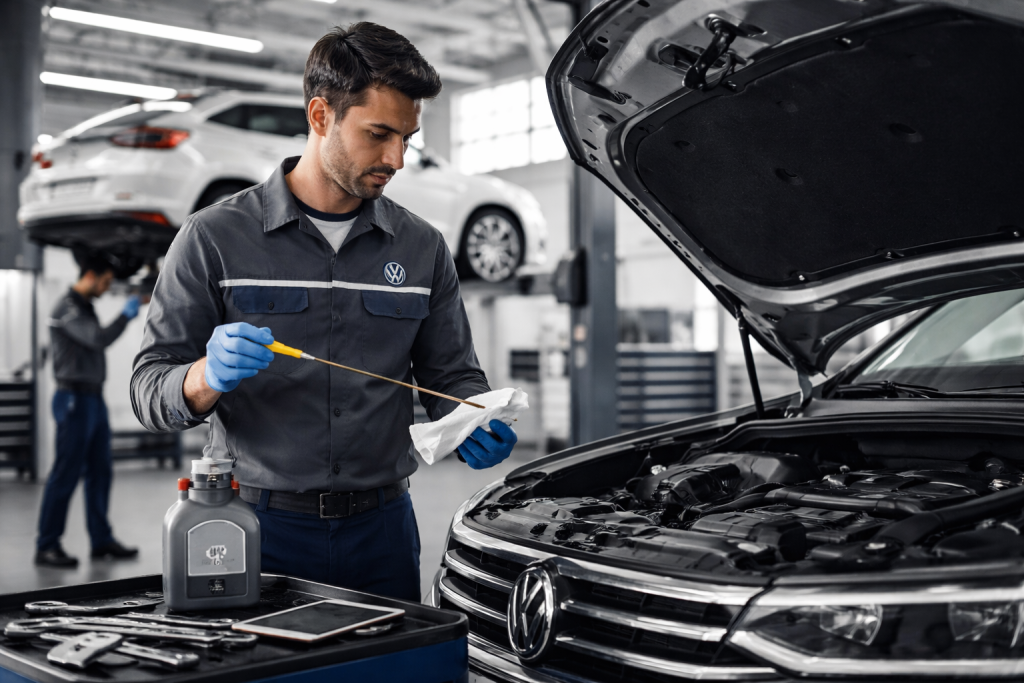
Volkswagen maintenance plans are designed to be performed by Volkswagen certified technicians who are trained specifically on Volkswagen vehicles and systems. These technicians use diagnostic tools and service procedures designed by Volkswagen engineers.

Service quality can influence several aspects of vehicle ownership:

• accurate diagnosis of developing mechanical issues
• correct service procedures for complex vehicle systems
• use of parts engineered for specific Volkswagen models

Volkswagen maintenance plans also emphasize the use of Genuine VW Parts during scheduled service visits. These components are designed to match the engineering specifications of Volkswagen vehicles.

Using manufacturer designed parts helps maintain proper fit, performance, and durability across major vehicle systems such as engine components, braking systems, and filtration systems.

For drivers who want maintenance performed according to manufacturer standards, OEM backed service can provide additional confidence in the quality of scheduled maintenance.

How to Evaluate Whether a Volkswagen Maintenance Plan Fits Your Ownership Strategy

Not every driver approaches vehicle ownership the same way. Some drivers prefer to handle maintenance expenses as they occur, while others prefer to plan maintenance costs in advance.

Evaluating whether a Volkswagen maintenance plan fits your ownership strategy typically involves considering several factors related to driving habits, ownership duration, and cost preferences.

Drivers often evaluate maintenance plans by considering:

• how long they plan to keep the vehicle
• how many miles they expect to drive each year
• whether they prefer fixed ownership costs
• how important manufacturer service standards are to them

Another factor that influences maintenance planning is the included Carefree Maintenance coverage available on many new Volkswagen vehicles. This program covers the first scheduled maintenance visits during the early ownership period.

After those initial services are completed, additional prepaid maintenance plans may extend coverage for later scheduled service intervals.

Understanding how included maintenance coverage and optional prepaid plans work together can help drivers determine whether extended maintenance coverage aligns with their long term ownership plans.

Understanding the Long Term Value of Volkswagen Maintenance Planning

Routine maintenance plays an important role in preserving vehicle performance, reliability, and long term ownership value. Scheduled service intervals help ensure that engine systems, braking components, and other critical systems continue to operate properly throughout the life of the vehicle.

Volkswagen maintenance plans provide a structured way to approach that responsibility by aligning service visits with manufacturer recommended maintenance schedules while locking in the cost of those services in advance.

For many drivers, this structure offers a balance between predictable ownership costs and manufacturer guided service quality. Understanding how maintenance plans work and what they cover allows vehicle owners to make more informed decisions about how they plan for long term vehicle care.
Posted in:

Related Posts

Volkswagen SUV Comparison Taos Tiguan Atlas and Cross Sport

Volkswagen SUV Comparison Taos Tiguan Atlas and Cross Sport

Start Your Volkswagen SUV Comparison With Space and Seating A Volkswagen SUV comparison starts with passenger space, cargo room, and the amount of vehicle you want around you. Volkswagen currently offers four distinct SUV paths through the Taos, Tiguan, Atlas Cross Sport, and Atlas. Each model fills a different role. The Taos keeps exterior dimensions compact while providing seating for five. The Tiguan adds more room within a two row layout. The Atlas Cross Sport moves into midsize territory while keeping two rows. The Atlas adds a third row and seating for up to seven. Which Volkswagen SUV should you research first? Start with the number of passengers you carry most. Then consider your normal cargo load and where you spend most driving time. A smaller SUV may make parking and city travel easier. A larger cabin may make family trips or gear loading simpler. Furthermore, a third row changes the decision when more than five seats are necessary. A useful starting path looks like this: Start with the Taos when you want five seats within Volkswagen's smallest SUV footprint. Move to the Tiguan when you want a roomier two row cabin without moving into a midsize SUV. Review the Atlas Cross Sport when five seats are enough but you want more cargo room. Choose the Atlas research path when three rows and seating for up to seven are priorities. Once you narrow the list, a detailed comparison page can answer the next set of questions. Volkswagen Taos for Compact Five Seat Driving The Volkswagen Taos sits at the smaller end of the Volkswagen SUV lineup. It seats five and provides 65.9 cubic feet of cargo volume with the rear seats folded. Is the Taos large enough for your needs? The answer starts with what you carry during a normal week. A couple, commuter, or smaller household may not need the exterior dimensions of a larger SUV. The Taos can also work for errands, bags, groceries, and weekend gear. Additionally, folding the rear seats opens substantially more room when passenger seating is not needed. Its smaller exterior size also deserves consideration around Jacksonville. Tighter parking spaces, garages, and busy shopping areas can make a compact SUV easier to place. However, choosing Taos does not mean skipping useful cabin space. Volkswagen gives the model a flexible rear seating area and a wide cargo opening. If Taos and Tiguan both remain on your list, move next to a direct comparison. Tom Bush Volkswagen already has a dedicated Taos versus Tiguan resource for that research step. That page should carry the detailed size and equipment comparison. This hub only needs to answer whether Taos belongs on your shortlist. Volkswagen Tiguan for More Two Row Family Space The current Volkswagen Tiguan gives five passengers a larger compact SUV cabin. It no longer uses the previous generation's optional third row. That distinction matters because older Tiguan articles may still mention seven passenger seating. Current Tiguan research should center on a two row layout with five seats. When should you move from Taos to Tiguan? Consider Tiguan when you want more cabin room while staying within the compact SUV class. Volkswagen lists 69.8 cubic feet of cargo volume with the second row folded. That creates more carrying room while keeping the vehicle below Atlas family dimensions. The current Tiguan also offers front wheel drive on several trims and available 4MOTION. The upper SEL R Line Turbo uses standard all wheel drive. A Tiguan shortlist makes sense when your priorities include: Five passenger seating with more cabin room than Taos. A larger cargo area without moving to the Atlas Cross Sport. Available 4MOTION on eligible trims. A two row layout that keeps rear passenger access straightforward. If you need more than five seats, Tiguan should not remain your final stop. The Atlas becomes the Volkswagen SUV to research next. If five seats are enough, compare Tiguan against Taos or Atlas Cross Sport based on desired vehicle size. Atlas Cross Sport for Larger Two Row Space The Volkswagen Atlas Cross Sport takes a different route. It gives five passengers midsize SUV dimensions without adding a third row. Who should research the Atlas Cross Sport? Start here when you want more cargo room and cabin space but still prefer two rows. Volkswagen lists 40.3 cubic feet of cargo volume behind the second row. Folding that row expands the area to 77.6 cubic feet. That gives the Atlas Cross Sport a noticeable cargo increase over the Tiguan. Therefore, the model makes sense for larger travel loads, sports gear, luggage, or bulky household items. The two row layout also means the rear cabin does not need to accommodate third row seating. This keeps the vehicle focused on five passengers and cargo space. The Atlas Cross Sport can be especially relevant when your shortlist includes Tiguan and Atlas. The decision is not only about exterior dimensions. Ask whether you need a third row. If the answer is no, compare your preferred cabin space and cargo needs next. If the Tiguan feels smaller than you want, Atlas Cross Sport deserves a closer look. If seven seats matter, move directly to Atlas research. Volkswagen Atlas When Three Rows Matter The Volkswagen Atlas is the clearest branch in this SUV comparison. It provides three rows and seating for up to seven passengers. Which Volkswagen SUV has three rows? Among these four models, the Atlas fills that role. Volkswagen also lists 96.6 cubic feet of cargo volume with the rear seating folded. That is the largest maximum cargo figure within this group. The third row changes how the Atlas serves family travel. Additional passengers can use dedicated seating without forcing someone into a two row arrangement. Cargo planning still matters when every seat is occupied. Therefore, families should consider how frequently they carry seven people and large bags at the same time. The Atlas deserves deeper research when your priorities include: Three rows for households that regularly carry more than five people. Seating for up to seven passengers. The largest maximum cargo volume among these four Volkswagen SUVs. A larger cabin for family trips, school activities, luggage, or sports gear. Atlas research can then move into more specific topics. Those may include trim selection, towing equipment, or a direct Atlas comparison. Drivers who do not need a third row should also review the Atlas Cross Sport. It keeps the larger Atlas family footprint while staying with five seats. Turn Your Shortlist Into the Next Research Step Choosing among Volkswagen SUVs becomes easier once the first major question is settled. Start with passenger count. Then review cargo space and overall vehicle size. If Taos and Tiguan remain close, use the dedicated Taos versus Tiguan comparison. That resource can handle the detailed distinctions this hub does not need to repeat. If Tiguan and Atlas remain on your list, compare how much cabin space you need. The Atlas also adds the third row that the current Tiguan does not provide. If Atlas Cross Sport and Atlas remain close, the seating question becomes central. Five seats point toward Atlas Cross Sport research. A third row points toward Atlas. From there, move into trim pages after choosing the model. Trim research can address equipment, drivetrain, seating details, and available cabin technology. Inventory should come after that model decision. Tom Bush Volkswagen provides separate inventory paths for each Volkswagen SUV, which makes it easier to review available configurations. Jacksonville drivers can use the same process whether they are replacing a smaller crossover or moving into a larger family SUV. Begin with seating. Compare the cargo room you expect to use. Then choose the deeper model resource that matches your remaining questions. That sequence keeps the Volkswagen SUV comparison focused. It also gives each existing comparison, trim guide, towing resource, and inventory page a clear purpose in your research.

Volkswagen ID. Buzz Trim Levels and Seating for 2027

Volkswagen ID. Buzz Trim Levels and Seating for 2027

Volkswagen ID. Buzz Trim Levels Across 2025 and 2027 Volkswagen ID. Buzz trim levels now span two U.S. model years with a gap between them. There is no 2026 U.S. ID. Buzz model. Volkswagen paused the nameplate after 2025 and confirmed its return for 2027. Therefore, shoppers may see remaining 2025 inventory while also researching the announced 2027 lineup. Therefore, model year context comes first when reviewing equipment. Additionally, the 2025 lineup includes Pro S, Pro S Plus, Pro S Plus with 4MOTION, and two 1st Edition versions. By contrast, 2027 brings Pro S RWD, Pro S 4Motion, Tourer 4Motion, and Pro S Plus 4Motion. However, Volkswagen has not announced pricing for the 2027 lineup. Which lineup should you review first? If you plan to buy soon, start by checking current stock. Additionally, compare upcoming 2027 trims if your buying timeline extends further. You can also check Tom Bush Volkswagen inventory for current ID. Buzz listings. Compare the 2025 Volkswagen ID. Buzz Lineup The 2025 Volkswagen ID. Buzz trim levels begin with Pro S and move through several higher trims. Additionally, Pro S uses rear wheel drive and a second row bench seat. Volkswagen lists seven person seating for this trim. Additionally, Pro S Plus adds more cabin and parking tech while retaining rear wheel drive. The 2025 lineup includes several configurations that change seating, drivetrain, and cabin equipment. Pro S uses rear wheel drive with a second row bench and seven person seating. Pro S Plus adds more cabin, parking, audio, access, and towing equipment. Pro S Plus with 4MOTION adds all wheel drive and pairs it with captain's chairs. The 1st Edition models add launch specific styling and equipment for the 2025 model year. What separates Pro S Plus from Pro S? Pro S Plus adds cabin, parking, audio, access, and towing equipment. Moreover, the trim change goes beyond the badge. Volkswagen lists a head up display, Area View, Harman Kardon audio, and a retractable tow hitch on Pro S Plus. In addition, hands free sliding door access joins the equipment list. The 1st Edition was limited to the 2025 model year. Volkswagen currently describes the 2025 First Edition with second row captain's chairs and six total seats. Therefore, the existing Tom Bush review should remove its current five person entry for the rear wheel drive 1st Edition. Seating and 4MOTION Shape the Cabin Layout Seating is one of the clearest ways to narrow Volkswagen ID. Buzz trim levels. Do you need six seats or seven? Both layouts appear within the 2025 lineup. A bench creates room for three people in the second row. By contrast, captain's chairs reduce that row to two seats and create a more open path through the cabin. For 2025, Pro S uses a second row bench and seats seven. Additionally, Volkswagen states that Pro S Plus and First Edition models use second row captain's chairs for six total people. However, earlier launch material described some rear wheel drive versions with a bench option. For this reason, shoppers should verify the exact seat layout on the specific vehicle they are considering. A few questions can narrow the configuration quickly before you start comparing smaller equipment differences. Choose a seven seat setup when maximum passenger space is the priority. Consider captain's chairs when easier third row access and separate second row seats matter more. Review 4MOTION configurations when all wheel drive is part of your vehicle search. Moreover, 4MOTION adds another filter to the decision. The 2025 Pro S Plus with 4MOTION and 1st Edition with 4MOTION use all wheel drive. In addition, those versions pair with second row captain's chairs. Therefore, drivers who want all wheel drive should expect a six seat layout in the verified 2025 trim. This pairing matters when you regularly carry more people. A seven seat bench may suit larger groups. By contrast, captain's chairs offer separate second row seating and easier movement toward the third row. Technology and Cabin Equipment by Trim Volkswagen ID. Buzz trim levels also separate themselves through cabin equipment. Pro S covers the core electric van layout, three row seating, and Volkswagen connectivity features. Additionally, Pro S Plus adds several items that change daily use with the ID. Buzz. What does Pro S Plus add over Pro S? It adds several cabin, parking, audio, access, and towing items. Volkswagen lists a head up display, Area View, and Harman Kardon audio. In addition, Volkswagen lists a retractable tow hitch and hands free access for the sliding doors and rear liftgate. The added equipment on Pro S Plus supports several distinct parts of the drive. The head up display places selected driving information closer to the driver's forward view. Area View uses exterior cameras to provide a surrounding view during low speed parking. Harman Kardon audio adds a 13 speaker setup with a subwoofer and amplifier. Hands free access adds another way to open the sliding doors and rear liftgate. Therefore, shoppers can review trims without relying on a long equipment list. Instead, start with seating and drivetrain. Then review the cabin tech you want to use most. In addition, confirm every listed item on the exact ID. Buzz before purchase, since equipment can vary by trim. What Changes With the 2027 Volkswagen ID. Buzz Lineup The 2027 Volkswagen ID. Buzz trim levels introduce a simpler four trim structure. Volkswagen has announced Pro S RWD, Pro S 4Motion, Tourer 4Motion, and Pro S Plus 4Motion. Consequently, all wheel drive reaches more of the 2027 lineup than it did in 2025. What is new about the Tourer 4Motion? The Tourer adds an overnight travel package to the ID. Buzz lineup. Reported items include a fold out mattress, window blinds, ventilation panels, outdoor chairs, and a table. Furthermore, the Tourer includes captain's chairs, a retractable tow hitch, a smart dimming roof, and 20 inch wheels. Additionally, 2027 updates include revised Travel Assist functions and updated infotainment software. A NACS adapter is also part of the announced package for easier access to compatible Tesla Supercharger locations. However, Volkswagen has not announced 2027 pricing yet. Therefore, final EPA range figures should wait for complete U.S. specs from Volkswagen. Therefore, 2027 research should focus on confirmed trim structure and announced equipment for now. Pricing and final spec details can be added to this page after Volkswagen publishes them. Match Your ID. Buzz Configuration to Current Inventory The right Volkswagen ID. Buzz trim starts with the way you plan to use the cabin. Therefore, seating is a useful first filter. Additionally, drivetrain is the next one. Beyond that, cabin tech can separate closely related trims. For this reason, seven seat shoppers should review verified bench seat trims first. By contrast, shoppers who prefer captain's chairs should focus on six seat versions. Additionally, all wheel drive shoppers should review 4MOTION models and confirm the seat layout for each one. If overnight travel interests you, the announced 2027 Tourer deserves closer review. Tom Bush Volkswagen offers a direct way to review these details against current ID. Buzz inventory in Jacksonville. However, any 2025 listings may differ by color, drivetrain, seating, and installed equipment. Therefore, reviewing the exact listing is the final step before choosing a trim. Even so, the ID. Buzz choice can stay straightforward. With that in mind, start with seating, then drivetrain, then the cabin equipment that matters for your plans. From there, review available inventory or continue watching for verified 2027 specs as Volkswagen releases them.

Volkswagen Golf GTI vs Golf R

Volkswagen Golf GTI vs Golf R Comparison Guide 2026

Volkswagen Golf GTI vs Golf R decisions start with two hatchbacks that share a basic shape but use very different drivetrains. The GTI sends power through the front wheels, while the Golf R uses 4MOTION all wheel drive. Both use a turbocharged 2.0 liter engine and a seven speed DSG transmission. However, output, traction hardware, price, and cabin equipment create two distinct choices. Engine Output and Acceleration The Golf GTI produces 241 horsepower and 273 pound feet of torque. The Golf R raises output to 328 horsepower and 295 pound feet of torque. Therefore, the Golf R carries 87 more horsepower before drivetrain differences enter the comparison. How much quicker is the Golf R? Volkswagen lists a 4.4 second zero to 60 mph time for the Golf R. Volkswagen lists 6.0 seconds for the Golf GTI. The gap comes from more engine output plus 4MOTION traction. Both models use the same basic engine family. Still, tuning and supporting hardware change the output target. The GTI keeps the formula simple with front wheel drive and a lighter entry price. The Golf R adds more power plus hardware that can send torque across both axles. That matters most when power demand rises quickly. A front driven layout asks the front tires to steer and transmit engine torque. By contrast, 4MOTION can distribute torque across four driven wheels. The Golf R can therefore use more of its output during hard acceleration. Neither model needs a spec sheet to feel distinct on a test drive. The GTI delivers quick response with less drivetrain hardware. The Golf R delivers stronger acceleration and more launch traction. Therefore, compare both from a stop and during highway merging. How Does 4MOTION Change the Golf R? 4MOTION changes how the Golf R sends torque to the road. The setup can route power between the front and rear axles. It also uses rear axle torque vectoring to vary torque across the rear wheels. What does that change from the driver's seat? The Golf R can distribute engine torque beyond the front axle. That changes traction during acceleration and corner exit. It also changes how the car responds when the pavement is wet. The Golf GTI uses front wheel drive. Therefore, its front tires handle steering plus drive torque. Volkswagen tunes the GTI chassis around that layout. The result keeps the car direct and simple without the extra all wheel drive hardware. The Golf R adds another layer. Its rear axle hardware can direct more torque toward one rear wheel when needed. That can sharpen rotation during cornering. It can also reduce how much work the front tires must handle under power. For Jacksonville roads, rain gives this comparison a useful local context. Wet pavement reduces available tire grip. Therefore, torque distribution can change how each car puts power down during acceleration. Still, all wheel drive does not replace careful driving. Tire quality, tread depth, road surface, and speed remain central to traction. For that reason, compare tire setup and tread along with drivetrain type. A test drive should include normal turns, moderate acceleration, and highway merging. Those moments reveal more than a straight line launch. They show how each drivetrain responds during the kind of driving you will repeat. Daily Driving, Ride, and Fuel Use The Golf GTI and Golf R share the same compact hatchback format. That means both fit similar parking spaces and carry similar passenger loads. However, their chassis settings, wheels, fuel use, and starting prices shape daily ownership differently. Is the Golf GTI easier to justify for commuting? Its lower starting MSRP and higher EPA estimates reduce the daily cost gap. Volkswagen lists the GTI at 24 mpg city, 32 highway, and 27 combined. The Golf R uses more fuel. Current EPA figures list 22 mpg city, 31 highway, and 25 combined. Therefore, shoppers who drive many miles may notice the difference across a year. Ride tuning also deserves attention. The GTI offers available DCC Adaptive Chassis Control on selected trims. The Golf R includes chassis hardware tuned around its higher output and 4MOTION layout. Wheel and tire choices matter here too. Larger wheels can change ride feel over broken pavement. Tire selection also changes grip, road noise, and steering response. Therefore, compare the exact cars in stock instead of relying only on trim names. For city travel, the GTI may feel simpler because less drivetrain hardware sits beneath the car. The Golf R brings more traction hardware and more output. Still, both remain compact hatchbacks with similar outward dimensions. Highway driving reveals another contrast. The GTI reaches merging speed with less drama than its entry price might suggest. The Golf R reaches those speeds faster and with stronger traction. Therefore, the real question is how much of that extra response you want every day. Interior, Cargo, and Equipment Cargo room does not separate these two hatchbacks very much. Current U.S. specifications list 19.9 cubic feet behind the rear seats for both. With the rear seats folded, both list 34.5 cubic feet. Does the Golf R give you more cargo room? No. The higher price does not buy a larger hatch area. Therefore, cargo should not drive the decision between these two models. Instead, compare cabin equipment and trim content. The Golf GTI starts lower and offers several trim levels. Upper GTI trims add features that narrow part of the equipment gap. The Golf R starts with a higher standard equipment level. Volkswagen highlights features such as a head up display and Harman Kardon audio. Heated and ventilated front seats also come standard. Leather seating and 19 inch forged wheels add another distinction. Both models use a 12.9 inch center display. Both also include Volkswagen digital driver information and IQ.DRIVE features. Therefore, the cabin comparison should focus on standard content, seating, audio, and trim specific details. A side by side walkaround works well here. Open both hatches and fold the rear seats. Sit in both front seats and compare bolstering. Then check visibility, display layout, and storage placement. That process prevents the higher price from creating false assumptions. The Golf R costs more because of drivetrain, output, chassis hardware, and included equipment. It does not create a larger hatchback. Is the Golf R Worth More Than the Golf GTI? The 2026 Golf GTI starts at $34,590 before destination and other charges. The 2026 Golf R starts at $49,455. That creates a $14,865 difference before taxes, fees, options, or dealer pricing. What are you paying for when you move to the Golf R? You gain 87 horsepower, 4MOTION, rear torque vectoring, and more standard equipment. You also move into a model with a much higher entry price. The Golf GTI keeps the core hot hatch formula more accessible. It delivers 241 horsepower, front wheel drive, a DSG transmission, and the same basic cargo space. Therefore, it can make more sense when price and fuel use carry more weight. The Golf R makes a different case. It adds more engine output and more complex traction hardware. It also includes equipment that pushes the cabin closer to the top of the Golf range. Neither choice needs to be framed as the wrong answer. The decision depends on what you want to pay for. Compare acceleration, traction, ride, cabin content, and monthly cost before choosing. At Tom Bush Volkswagen, reviewing both models in person makes the differences easier to judge. Start with the GTI if value and simplicity lead your list. Then drive the Golf R if added output and 4MOTION appeal to you. The better fit will become clearer once you compare the hardware, price, and driving feel side by side.